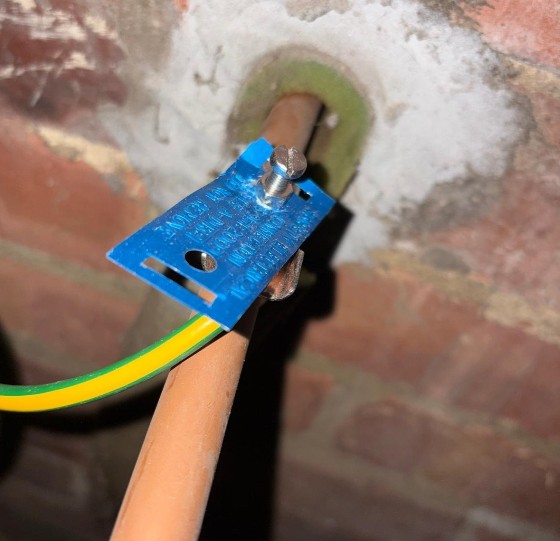
Has a gas engineer, utility company, plumber or electrician told you that no main protective bonding is visible on your gas or incoming water pipe?
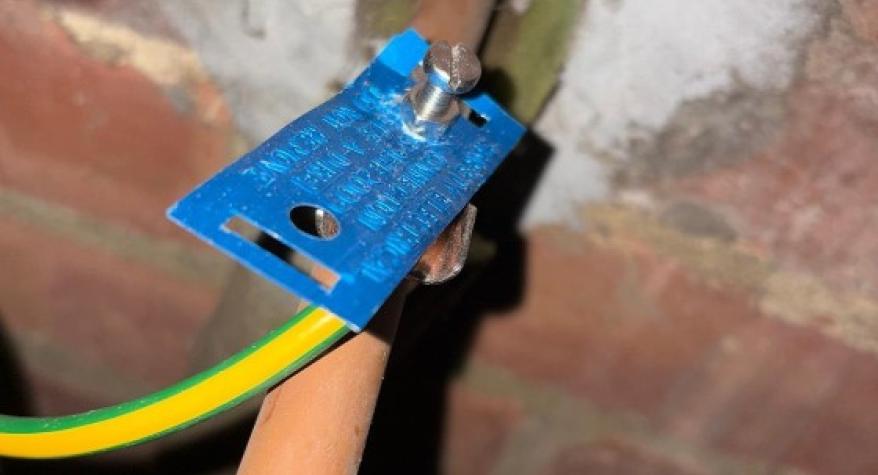
You may have found a warning card beside the gas meter, had the issue raised during an EICR or been told about it when an electrician arrived to complete a completely different job.
Customers often ask me:
“I’ve had a good plumber work on my boiler and pipework. Why did they never mention it?”
“The gas supplier checked my meter and did not tell me I needed bonding.”
“Most of the houses on this street seem to be the same.”
“I bought the house like this and nobody raised it during the sale.”
These are all reasonable questions.
Main protective bonding does not make your boiler, gas meter or water supply work. It forms part of the property’s electrical safety arrangements, which is why the issue is often identified by an electrician.
I’m Glynn from GFS Electrical Services Ltd, a local electrician based in Morley. I inspect, test and install main protective bonding for homeowners and landlords in Morley, Gildersome and the surrounding area.
I do not automatically install a bonding conductor simply because one cannot be seen. I first inspect the installation and establish whether the gas or water pipework genuinely requires bonding.
Where work is needed, I will explain the available cable routes, provide a clear quotation, complete and test the installation and issue the appropriate electrical documentation.
Main protective bonding conductors connect confirmed extraneous-conductive-parts to the electrical installation’s main earthing terminal.
An extraneous-conductive-part is conductive metalwork that is not part of the electrical installation but is capable of introducing an electrical potential into the property, generally Earth potential.
Qualifying incoming metallic gas and water installation pipes may be extraneous-conductive-parts. Where this is confirmed, a suitably sized green-and-yellow bonding conductor connects the pipework to the property’s main earthing terminal.
The purpose is to reduce a potentially dangerous voltage difference between the incoming metallic pipework and the electrical installation’s earthed metalwork during a fault.
Not every copper pipe or metallic service automatically requires bonding. The pipework must first be confirmed as an extraneous-conductive-part.
Why can missing bonding present a risk?
Imagine that an electrical fault causes the metal casing of a cooker to rise towards 230 volts.
At the same time, a metallic water pipe entering through the ground may remain close to Earth potential.
If someone touched the cooker and a metal tap at the same time, their body could bridge the difference in voltage and they could receive an electric shock.
Main protective bonding connects confirmed extraneous-conductive-parts to the installation’s main earthing terminal. This helps reduce the voltage difference between metal parts that may be touched simultaneously.
The bonding conductor is not used as the property’s electrical earth. It works alongside the installation’s earthing conductor, circuit protective conductors, RCDs and circuit breakers.
“My plumber has never told me that bonding was needed”
A good plumber may have serviced your boiler, replaced radiators, installed taps or altered your pipework without identifying a plumbing problem.
That does not necessarily confirm that the property’s electrical bonding arrangements are adequate.
The plumber may not have been carrying out an assessment of the electrical installation. Their work may have been limited to the boiler or plumbing task they were asked to complete.
Main protective bonding forms part of the electrical installation, so the issue is commonly identified when an electrician inspects the property’s earthing and bonding arrangements.
It does not mean that your plumber has done anything wrong. They may simply have been carrying out a different type of work.
“The gas supplier checked my meter and said nothing”
A gas engineer or meter operator may inspect the gas meter and associated equipment without carrying out a complete assessment of the property’s electrical installation.
Sometimes the engineer notices that no bonding connection is visible and leaves a card, label or warning notice near the meter.
The notice may include the telephone number of a company that can arrange the work. However, customers are not always clearly told what the notice means or that further action may be needed.
The card may be left inside the meter cupboard, attached to the nearby pipework or included with other paperwork from the visit. It can easily be overlooked, particularly because the gas supply, boiler and appliances continue working normally.
Main protective bonding is not needed to make the gas system operate. It is an electrical protective measure.
You are also not normally restricted to using the company whose telephone number appears on the card. You can contact a competent electrician of your choice to inspect the installation and provide a quotation.
Does a gas-company warning card prove that bonding is required?
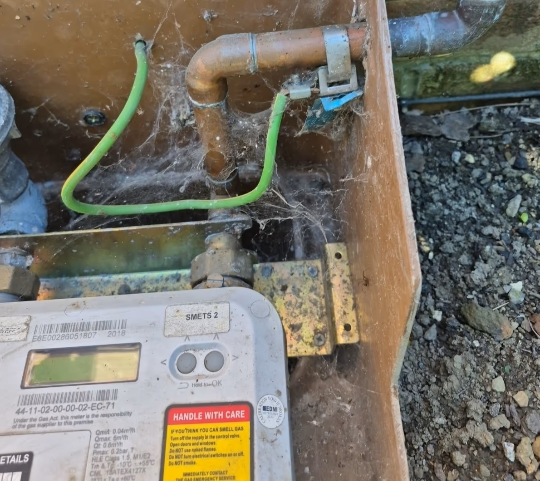
Not necessarily.
The card may only state that bonding was not visible during the gas engineer’s visit. That does not always prove that the conductor is completely absent.
The bonding may be hidden, connected further along the pipework, incorrectly positioned, damaged, disconnected or not clearly labelled.
Alternatively, it may genuinely be missing.
An electrician should inspect the electrical supply, identify the main earthing terminal and check whether an effective main protective bonding conductor is present.
Where visual inspection alone does not provide the answer, testing may be needed before deciding what work is required.
“Most of the houses on my street are the same”
Several houses on the same street may have been built at the same time and may appear to have similar electrical and plumbing arrangements.
However, neighbouring properties can still be different.
One house may have a metallic incoming water service while another has a plastic service. A property may have an insulating section in the pipework, hidden bonding beneath the floor or altered pipework following previous building work.
Gas and water meters may also have been replaced or moved at different times.
The fact that another property has no visible bonding does not confirm whether your own pipework requires it. Each installation should be assessed individually.
“I bought the house like this and nobody mentioned it”
A normal house purchase does not necessarily include a detailed inspection and testing of the electrical installation.
A general property survey is not the same as an Electrical Installation Condition Report.
Even where previous electrical certificates are available, the actual installation should still be inspected.
At one recent property, the paperwork supplied for a rewire stated that the gas and water services had main protective bonding. When the installation was inspected approximately ten years later, neither bonding conductor had actually been installed.
The customer had every reason to believe that the work recorded on the certificate had been completed. The difference between the paperwork and the physical installation was only discovered during a later EICR.
This is why an electrician should check what is actually present rather than relying entirely on older paperwork.
Why do I check bonding before carrying out other electrical work?

I often discover a bonding issue when I have been asked to complete a completely different job, such as installing a shower, adding a socket or altering an existing circuit.
As part of my initial verification, I check the origin of the electrical supply and the condition of the existing earthing and bonding arrangements.
When I issue a Minor Electrical Installation Works Certificate, Part 2 requires me to record the presence and adequacy of the installation’s earthing and bonding arrangements.
The certificate includes specific entries for the earthing conductor and main protective bonding conductors to water, gas, oil, structural steel and other applicable parts.
I cannot simply complete the requested electrical work and tick the certificate without carrying out the appropriate checks.
Gas and water bonding on Scott Green Crescent, Gildersome
I attended a property on Scott Green Crescent in Gildersome to install a shower.
Before beginning the installation, I checked the electrical supply, earthing and main protective bonding arrangements. My checks confirmed that the incoming gas and water services required bonding.
The gas meter was close to the main earthing connection, so the cable route was short and accessible.
The gas bonding took approximately 30 minutes to install and used around £10 of materials. The total charge was £95, including my labour and materials.
The incoming water pipe was on the opposite side of the property. That connection required a longer cable route, more material and considerably more installation time.
The water bonding cost £150, including labour and materials.
This shows why gas and water bonding at the same property can have different prices. The cost is mainly determined by the distance, accessibility and route between the main earthing terminal and each bonding location.
Missing bonding discovered after a previous rewire
At a property on Spring View in Gildersome, I was asked to complete remedial work following an EICR.
The home had been rewired approximately ten years earlier. The electrical certification supplied for the rewire recorded that main protective bonding was present to both the gas and water services.
However, when the installation was physically inspected, neither service had actually been bonded.
The written record did not match the installation.
Fortunately, the property had access beneath the timber ground floor. I was able to crawl beneath the floorboards and route the bonding conductor from the electrical supply position to the gas pipe and then continue to the incoming water pipe.
Because both bonding locations could be reached through one practical underfloor route, I completed the gas and water bonding for £150 in total, including labour and materials.
This example shows why paperwork should be supported by physical inspection and testing.
A solid concrete floor on Ingle Crescent, Morley
At a property on Ingle Crescent in Morley, the ground floor was solid concrete.
There was no suitable route beneath the floor, and taking the bonding conductor through the first floor to the opposite side of the house was not practical.
I discussed two options with the customer.
The first option was to install trunking discreetly above the internal skirting boards. That route would have cost approximately £175, including labour and materials.
The customer preferred not to have visible trunking running through the home. They chose to have the green-and-yellow conductor clipped neatly around the outside of the property instead.
The external route required more cable, additional fixings and more installation time. The completed external installation cost £300, including labour and materials.
I explained the appearance and cost of both options before starting so the customer could decide which route best suited the property.
No visible water bonding on King George Avenue, Morley
At a property on King George Avenue in Morley, I checked the electrical supply and bonding arrangements before starting the requested electrical task.
The gas bonding was clearly visible and could be confirmed. However, I could not visually identify a main protective bonding conductor connected to the incoming water pipe or stop tap.
Rather than automatically installing a new conductor, I carried out the relevant testing.
The results established that the water stop tap and internal pipework were electrically separated from external influences.
The water pipe was not an extraneous-conductive-part and did not require main protective bonding.
No unnecessary conductor was installed.
This is an important distinction: no visible bonding does not automatically mean that bonding is required.
The correct approach is to inspect the installation and, where necessary, test it before recommending the work.
How much does main protective bonding cost?
Based on recent jobs completed in 2026, the cost has ranged from approximately £95 to £300, including labour and materials.
Recent examples include:
- Straightforward gas bonding close to the main earthing terminal: £95
- A longer single water-bonding route: £150
- Gas and water bonding with good underfloor access: £150
- Gas and water bonding using a longer external route: £300
- These are genuine examples rather than fixed quotations.
The final price depends on whether gas, water or both require bonding, the distance from the main earthing terminal, the construction of the property and the cable route available.
Access beneath timber floors can reduce the amount of visible cable and installation time. Solid concrete floors may require internal trunking or a longer external route.
I will explain the available options and confirm the cost before starting any additional work.
What should I send when requesting a quotation?
Photographs can help me understand the likely work and cable route before visiting.
Please send photographs showing:
- The consumer unit
- The electrical supply and main earthing connections
- The gas meter and surrounding pipework
- The incoming water pipe and stop tap
- Any visible green-and-yellow conductors or clamps
- The gas-company warning card
- The relevant EICR observation, where applicable
Please also provide the property postcode and confirm whether the concern relates to gas, water or both.
A site inspection and electrical testing may still be required before I can confirm whether bonding is necessary and provide the final price.
Why choose GFS Electrical Services Ltd?
I’m Glynn, a local electrician based in Morley with more than 30 years of experience in domestic electrical work.
I carry out the inspection, quotation, installation and testing myself, so you deal with the same person throughout the job.
I will not automatically install a bonding conductor simply because one cannot be seen. I will first establish whether the gas or water pipework is an extraneous-conductive-part and whether main protective bonding is genuinely required.
Where work is necessary, I will explain the cable-route options, provide a clear quotation, complete the installation neatly and test the finished connection.
Have you been told your gas or water bonding is missing?
Contact GFS Electrical Services Ltd if a gas engineer, utility company, plumber, EICR inspector or electrician has told you that no main protective bonding is visible.
I can inspect the existing arrangements, establish what is actually required and provide a clear quotation for completing the work.
Call Glynn on 0113 403 1300 to discuss main protective bonding in Morley or Gildersome.